Call US TODAY - 716-205-8089

Some people wake up stiffer than when they went to bed.
The first few minutes out of bed can feel slow, tight, and sore.
For many people this eases within half an hour of moving around. For others it lingers, keeps returning, or slowly gets worse over months.
Morning stiffness is common, and it is usually not a sign of something serious. But the pattern of how long it lasts and what makes it better is worth paying attention to, especially when lower back pain keeps showing up first thing in the day.
Sleep is the longest stretch of the day without movement.
Joints and soft tissues rely on motion to stay lubricated and comfortable. When the body stays still for seven or eight hours, tissues can feel tight when you finally ask them to move.
A few things tend to overlap overnight:
Most morning back pain comes from a mix of these rather than one single cause.
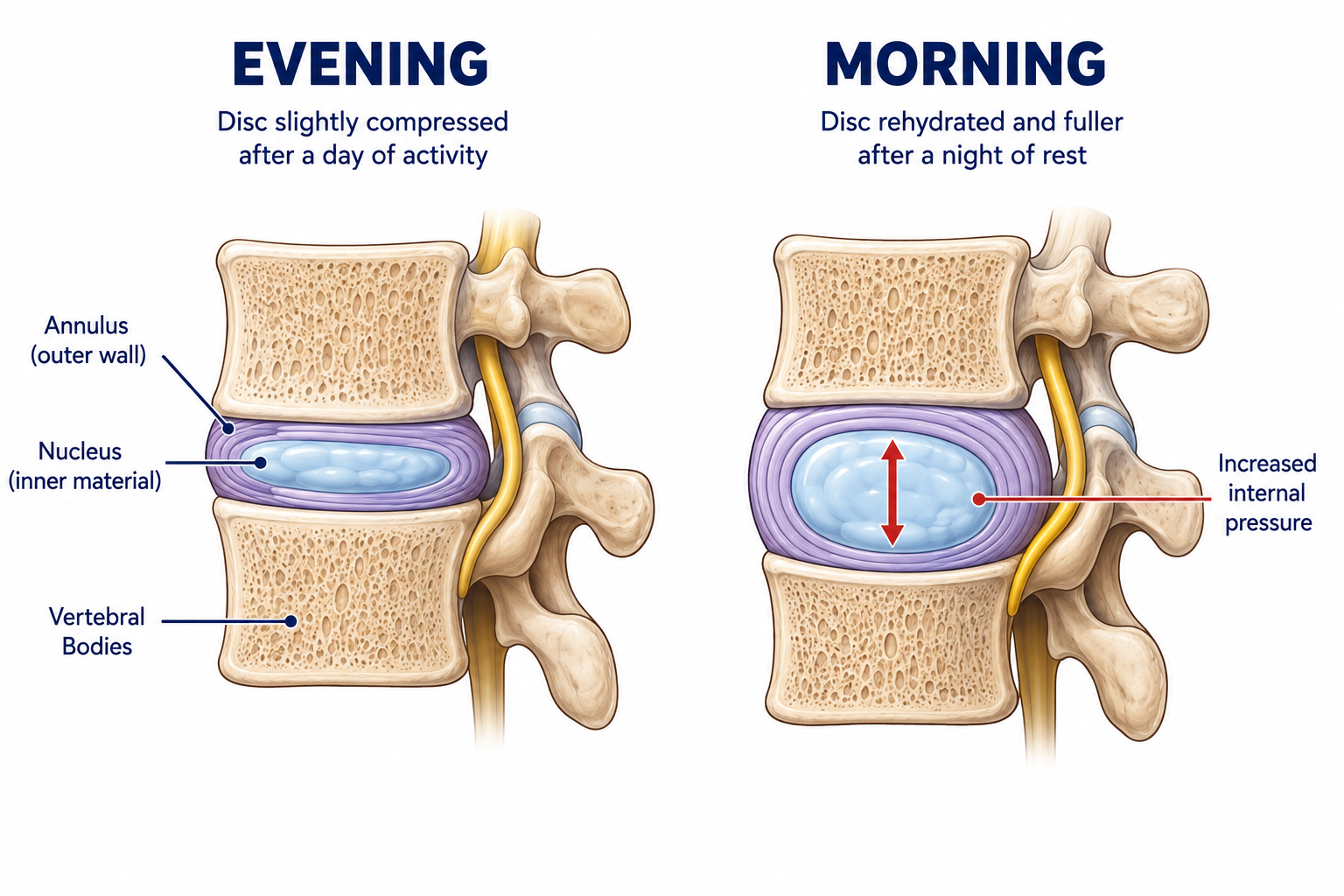
Spinal discs behave a little like sponges.
During the day, upright posture and gravity gradually press fluid out of them. Overnight, lying down lets that fluid return.
This is normal and healthy. It is also why most people are measurably taller in the morning than at night.
The tradeoff is that discs are at their most fluid filled right when you wake up. Pressure inside the disc space is slightly higher, which can make early morning bending, twisting, and lifting feel less comfortable.
This is one reason it may help to avoid heavy lifting or aggressive stretching in the first twenty or thirty minutes after getting up.
If disc irritation is already part of your picture, this article may also help: Herniated Disc vs Bulging Disc: What Is the Difference?
Sleep position does not cause most back pain, but it can make an irritated back harder to settle.
A position that leaves the lower back unsupported for hours tends to be felt in the morning rather than at night.
Common patterns worth noticing:
Mattresses matter less than most marketing suggests, but a genuinely worn out mattress can keep a back irritated night after night.
For a closer look at position specifically, this may help: Best Sleeping Positions for Lower Back Pain
This is the distinction most articles skip, and it is the one that matters most.
Mechanical stiffness comes from joints, discs, and muscles. It usually eases with movement, improves within about thirty minutes, and responds to changing position.
Inflammatory stiffness behaves differently. It tends to last longer, often more than thirty to sixty minutes, and rest can make it worse rather than better.
A few patterns raise the question of an inflammatory cause:
Meeting some of these does not mean you have an inflammatory condition. Many people with ordinary mechanical back pain check a box or two.
It does mean the pattern is worth describing accurately to a provider, because the two are managed differently.
The goal in the morning is gentle motion, not aggressive stretching.
Because discs are most fluid filled early, deep forward bending right out of bed is usually the least comfortable choice.
Things many people find helpful:
If a stretch increases pain or sends symptoms into the leg, that is a reason to stop and have it looked at rather than push through.
Most morning stiffness is not urgent.
It may help to have things checked if you notice:
Some symptoms deserve prompt medical attention rather than a routine appointment. These include new or worsening leg weakness, numbness around the groin or inner thighs, loss of bladder or bowel control, fever alongside back pain, or unexplained weight loss.
Those are uncommon. They are also the ones worth knowing.
Care depends on what the examination actually finds.
Morning symptoms coming from joint stiffness and limited movement are approached differently than symptoms driven by disc irritation or nerve involvement.
Depending on findings, care may include spinal manipulation, manual therapy, mobility work, or postural correction therapy when sustained positions are part of the picture.
Chiropractic care is one part of conservative care, and it is not appropriate for every cause of morning back pain. Suspected inflammatory conditions, for example, generally need medical evaluation and bloodwork alongside any hands on care.
That pattern is common with mechanical stiffness. Hours without movement leave joints and muscles tight, and motion through the morning usually settles it.
Mechanical stiffness often eases within about fifteen to thirty minutes. Stiffness that regularly lasts longer than thirty minutes is worth mentioning to a provider.
Not reliably. Medium firm tends to suit more people than very firm, but the best mattress is generally the one that lets you sleep comfortably without waking to change position repeatedly.
Gentle movement is usually fine. Deep forward bending in the first twenty or thirty minutes is often the least comfortable option because discs are most fluid filled at that time.
It can contribute, especially over months. It is more often a factor that keeps an already irritated back from settling than the single original cause.
At Niagara Falls Spine & Chiro, we look at how your spine moves, how long your symptoms last, and what pattern they follow through the day.
If morning stiffness keeps returning or has been slowly getting worse, an examination can help identify what is driving it.



Niagara Falls Spine & Chiropractic
716-205-8089 • 2303 Pine Ave, Niagara Falls, NY 14301