Call US TODAY - 716-205-8089

Sleep is one of the few things you do for seven or eight hours straight.
That makes position worth thinking about when your back is already sore.
There is no single best sleeping position for everyone. The position that helps one person can bother the next, and it often depends on what is irritated in the first place.
What follows is how each common position tends to affect the lower back, and what usually makes each one more comfortable when lower back pain is part of your night.
The lower back has a natural inward curve.
Positions that hold that curve near neutral for hours are generally easier on the joints and discs. Positions that flatten it or exaggerate it for a long stretch tend to be felt later.
The key word is hours. A position that feels fine for two minutes can still be uncomfortable by morning.
This is also why symptoms from sleep position usually show up on waking rather than while you are falling asleep.
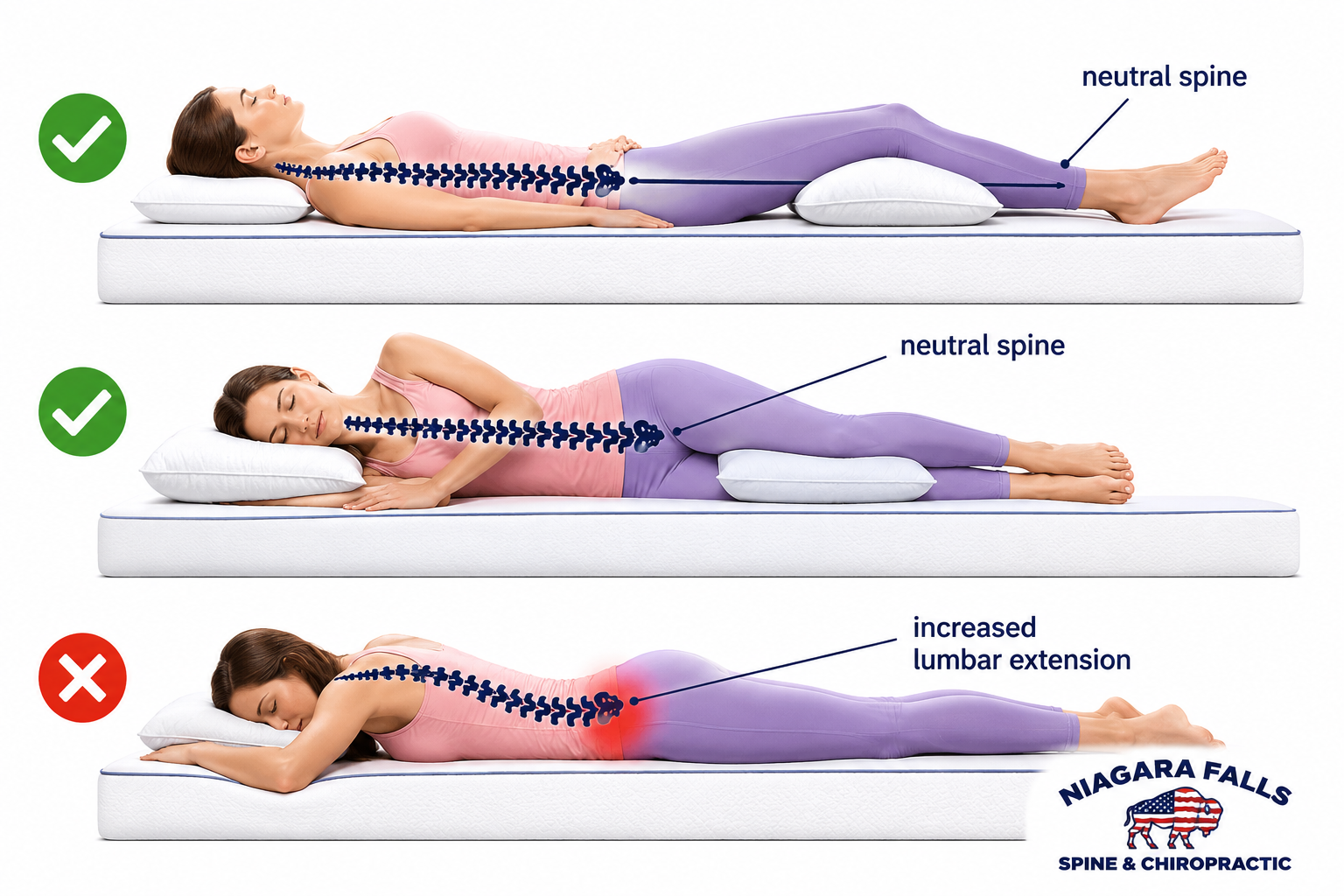
Back sleeping spreads your weight across the widest surface area.
For many people with lower back pain it is the easiest position to tolerate, but only with one adjustment.
Lying flat with the legs straight pulls on the hip flexors and can increase the arch in the lower back. A pillow under the knees takes that tension off.
What tends to help:
Back sleeping is not the right answer for everyone. It can worsen snoring and sleep apnea, and some people with spinal stenosis find it less comfortable than a slightly flexed position.
Side sleeping is the most common position, and it works well for a lot of irritated backs.
The problem is what the top leg does. When it falls forward across the body, the pelvis rotates and the lower back twists for hours.
A pillow between the knees keeps the hips stacked and stops that rotation.
What tends to help:
Curling into a tight fetal position is a common instinct when the back hurts. It can feel good briefly, but holding deep flexion all night often leads to more stiffness by morning.
Stomach sleeping is generally the hardest position for a sore lower back.
It holds the lumbar spine in extension for hours, and it forces the neck to stay rotated to one side so you can breathe.
That said, telling someone to simply stop is rarely useful. Sleep position is a deeply set habit, and most people return to their preferred position once they are asleep.
If you sleep on your stomach and do not want to change:
The three quarter variation is often the most realistic step for committed stomach sleepers.
Weight spreads evenly and the spine stays close to neutral.
Comfortable for most people once the hips are kept stacked.
Holds the lower back extended and the neck rotated all night.
Most of the benefit in each position above comes from one small support change.
Under the knees for back sleepers. Between the knees for side sleepers. Under the hips for stomach sleepers.
Those three adjustments do more for a sore lower back than switching positions entirely, and they are far easier to actually keep overnight.
Your head pillow matters too. The goal is a neutral neck, level with the rest of the spine, rather than propped high or dropped low.
If neck symptoms are also part of the picture, this article may help: Is Your Shoulder Pain Actually Coming From Your Neck?
Mattress advice is heavily marketed and lightly supported.
Medium firm suits more people with lower back pain than very firm does, but individual comfort still varies a great deal.
A mattress is more likely to be part of the problem when:
Before replacing a mattress, it is usually worth trying the pillow adjustments above for a couple of weeks. They cost nothing and they resolve a fair number of cases.
This section matters as much as the positions themselves.
Sleep position is a contributing factor far more often than it is a root cause. Changing it helps an irritated back settle, but it does not address what irritated the back in the first place.
Position is probably not the main issue when:
In those situations, adjusting pillows is reasonable but it is not the answer on its own. Something is driving the symptoms during the day, and that is what needs looking at.
Consider an evaluation if back pain regularly disrupts your sleep, keeps returning, or is not improving after a few weeks of sensible self care.
Seek prompt medical attention rather than waiting if you develop new or worsening leg weakness, numbness around the groin or inner thighs, loss of bladder or bowel control, or severe pain following a significant fall or accident.
Depending on what an examination finds, care may include spinal manipulation, manual therapy, or flexion distraction therapy when disc irritation is contributing.
For most people it is back sleeping with a pillow under the knees, or side sleeping with a pillow between the knees. The better answer is whichever of those you can actually stay in comfortably.
It helps some people short term, usually because it removes a sagging mattress from the equation. It is not necessary, and for many it simply trades one discomfort for another.
A few nights in a recliner can be reasonable during an acute flare, particularly with disc related pain. Weeks of it tends to stiffen the hips and lower back, so it is best treated as temporary.
Long stretches without movement allow joints and muscles to stiffen, and discs take on fluid overnight. Both make the first movements of the day feel harder.
For side sleepers it often does. It stops the top leg dropping forward, which keeps the pelvis from rotating and the lower back from twisting for hours.
At Niagara Falls Spine & Chiro, we look at what is irritating your back during the day as well as what position you hold it in at night.
If back pain is disrupting your sleep or you wake up sore most mornings, an examination can help identify what is contributing.



Niagara Falls Spine & Chiropractic
716-205-8089 • 2303 Pine Ave, Niagara Falls, NY 14301