Call US TODAY - 716-205-8089

A bulging disc and a herniated disc are not exactly the same injury.
A bulging disc usually means that part of the disc’s outer wall extends beyond its normal boundary while the inner material remains contained. A herniated disc occurs when the softer center pushes through a crack or weak area in the outer layer.
Both can occur in the neck or lower back. Both can also exist without causing pain. Symptoms are more likely when the affected disc irritates or presses on a nearby nerve. Herniated discs tend to extend farther and are more likely to produce painful nerve inflammation or compression.
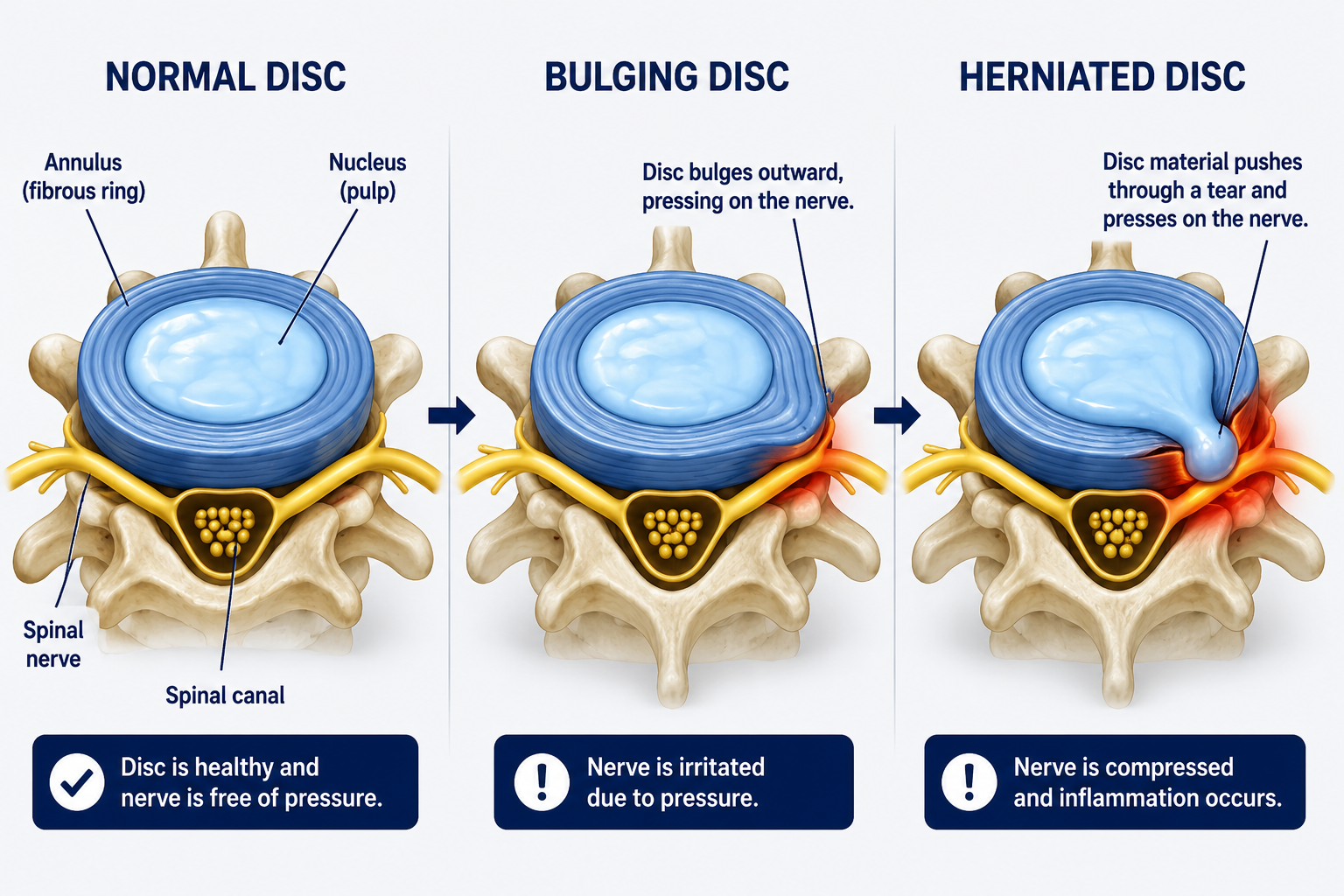
Your spine is made of bones called vertebrae. A flexible disc sits between most of these bones.
Each disc has two main parts:
The discs cushion the vertebrae, help absorb force, and allow the spine to bend and move.
Over time, discs may lose moisture and flexibility. The outer ring may weaken, stretch, or develop small cracks. These changes can lead to a disc bulge or herniation.
A bulging disc occurs when the outer portion of the disc extends outward beyond its normal position.
The bulge often affects a broader section of the disc rather than one small point. The outer wall is stretched, but the soft center usually remains contained inside it.
A bulging disc may develop because of:
A bulging disc is not always painful. Many people learn they have one only after undergoing an MRI for another reason.
Symptoms may begin when the bulge narrows the space around a nerve, contributes to spinal stenosis, or causes inflammation in nearby tissue.
A herniated disc occurs when part of the soft inner material pushes through a tear or crack in the disc’s outer layer.
This may also be called a:
Unlike a broad bulge, a herniation is often more focused in one area. The displaced material may come close to a spinal nerve or enter the space around it.
A herniated disc can cause pain through direct pressure on the nerve. It may also trigger inflammation around the nerve root, even when the amount of physical pressure is limited.
The main differences are:
A herniated disc is not automatically more serious than a bulging disc.
The name of the disc change matters less than:
A small herniation may cause no symptoms. A broad bulge in a tight area may irritate a nerve and cause significant pain.
The MRI finding must be compared with the person’s symptoms and physical examination. A scan alone cannot always prove which structure is causing pain.
It can, but it does not always happen.
A weakened or bulging disc may develop a tear in its outer layer. If the inner material moves through that tear, the disc may then be described as herniated.
Many disc bulges remain stable. Some become smaller over time, while others continue to change as part of disc degeneration.
Having a bulging disc does not mean that a herniation is inevitable.
Both conditions can cause similar symptoms. The location of the affected disc often determines where those symptoms appear.
A lumbar disc problem may cause:
Pain that travels from the lower back through the buttock and leg is often called sciatica. A herniated disc in the lower spine can irritate a nerve root and cause this pattern.
A cervical disc problem may cause:
These symptoms may overlap with a pinched nerve. A cervical herniated disc can irritate a nerve that serves the shoulder, arm, or hand.
Yes.
A disc may affect a nerve and cause leg pain without producing much lower back pain. The same is true in the neck: arm symptoms can sometimes feel stronger than the neck pain.
Some people have a bulging or herniated disc with no symptoms at all. Imaging may reveal the change even though it is not responsible for the person’s current discomfort.
This is why treatment should focus on the complete symptom pattern rather than the scan wording alone.
Disc changes often develop over time. As discs lose moisture, they become less flexible and more likely to stretch or tear.
Possible contributing factors include:
A disc problem can also appear without one clear injury.
Diagnosis usually begins with a history and physical examination.
The clinician may check:
An X-ray does not show the soft disc clearly. It may help identify fractures, alignment changes, arthritis, reduced disc height, or another possible cause of pain.
An MRI provides a clearer view of discs, nerves, and other soft tissue. It may show:
Imaging is not always needed at the beginning. It may be considered when symptoms are severe, weakness is present, red flags appear, or symptoms do not improve as expected.
Not always.
A larger disc change may cause limited symptoms if it does not affect sensitive tissue. A smaller herniation may cause strong pain if it irritates a nerve root in a confined space.
Pain can also be influenced by:
The scan and the symptoms need to make sense together.
Symptoms often improve without surgery.
A herniated disc does not always return to its original appearance, but inflammation can decrease and the body may gradually reduce some displaced disc material. The nerve may become less sensitive as pressure and irritation settle.
Many symptomatic herniated discs improve over time with conservative care. Recovery time depends on the location, severity, nerve involvement, overall health, and demands placed on the spine.
Treatment is usually based on symptoms rather than the label alone.
A conservative care plan may include:
Avoiding every movement may lead to stiffness and weakness. The goal is usually to remain active within a tolerable range while temporarily changing movements that sharply increase symptoms.
Long periods of bed rest are generally not recommended. Gentle exercise and a gradual return to activity often form part of initial care.
Exercises may focus on:
The right exercise depends on whether the disc problem is in the neck or lower back and whether nerve symptoms are present.
After fractures, severe neurological problems, and other urgent conditions have been ruled out, conservative treatment may help address movement restrictions, muscle tension, and mechanical stress around the affected area.
Depending on the examination, care may include manual therapy, flexion-distraction therapy, gentle spinal manipulation, soft-tissue work, or guided exercises.
The technique should match the condition, symptoms, and stage of recovery. A painful disc should not be treated with the same approach in every patient.
A physician may recommend pain medication, anti-inflammatory medication, muscle relaxers, or other options based on medical history.
Spinal injections may sometimes be used when severe arm or leg pain continues despite conservative care. These injections may reduce inflammation around a nerve but do not physically repair the disc.
Most disc problems do not require surgery.
Surgical evaluation may be considered when:
A discectomy removes disc material that is pressing on a nerve. It is generally reserved for selected cases rather than used as the first treatment.
Seek urgent medical attention if neck or back symptoms occur with:
Bladder or bowel changes, saddle-area numbness, and worsening leg weakness may point to cauda equina syndrome. This is a medical emergency caused by compression of the nerve roots at the bottom of the spinal canal.
Keep the object close, bend through the hips and knees, and avoid twisting while carrying a heavy load.
No posture is ideal for hours at a time. Alternate between sitting, standing, and walking when possible.
Stronger trunk, hip, back, and shoulder muscles may help the body manage daily loads.
Increase exercise volume, lifting weight, and physical work in steps rather than all at once.
Smoking may reduce blood flow to spinal discs and contribute to faster breakdown.
Pain that begins traveling into an arm or leg, new numbness, or weakness deserves more attention than ordinary muscle soreness.
No. A bulging disc usually means the outer wall extends outward while the inner material remains contained. A herniated disc means inner material has pushed through a crack or tear in the outer wall.
A herniated disc is more likely to irritate a nerve, but either condition may cause severe symptoms. The location and nerve involvement matter more than the name alone.
Yes. A lumbar disc bulge can irritate or compress a nerve that contributes to the sciatic nerve, causing pain, tingling, numbness, or weakness in the leg.
Yes. Most people improve with time and conservative treatment. Surgery is usually considered only when severe or progressive nerve symptoms continue.
Conservative care cannot guarantee that a disc returns to its original shape. Chiropractic and manual treatments may help some patients manage pain, improve movement, reduce surrounding tension, and return to activity when they are appropriate for the condition.
No. A bulging disc that causes no symptoms may not need treatment. Care is usually directed at pain, nerve symptoms, weakness, and reduced function.
Not directly. X-rays show bone and alignment. MRI provides a clearer view of discs, nerves, and other soft tissue.
A brief period of modified activity may help during a severe flare, but prolonged bed rest may contribute to stiffness and weakness. Gentle movement is often encouraged when it can be performed safely.
Some people improve within several weeks. Others need several months, especially when nerve irritation is significant. Symptoms should generally trend toward better movement, less radiating pain, and improved daily function.
A bulging disc stretches outward while keeping its inner material contained. A herniated disc develops a tear that allows some inner material to push through.
That distinction helps describe the anatomy, but it does not determine your pain level by itself.
The most important questions are whether a nerve is affected, whether weakness is present, and whether your symptoms are improving.
If neck or back pain is traveling into an arm or leg, numbness or weakness has developed, or symptoms continue to limit your daily life, schedule an evaluation with Niagara Falls Spine & Chiropractic.



Niagara Falls Spine & Chiropractic
716-205-8089 • 2303 Pine Ave, Niagara Falls, NY 14301