Call US TODAY - 716-205-8089
Not all pain behaves the same way.
A tight, aching shoulder and a sharp line of pain running down the arm can both start in the neck, but they are coming from different tissues.
Telling them apart matters because they respond to different things. Muscle tension often eases with movement and heat. Nerve irritation sometimes gets worse with the same approach.
This is a general guide to how each one tends to present, where people most often confuse them, and when nerve symptoms need to be looked at promptly rather than stretched at home.
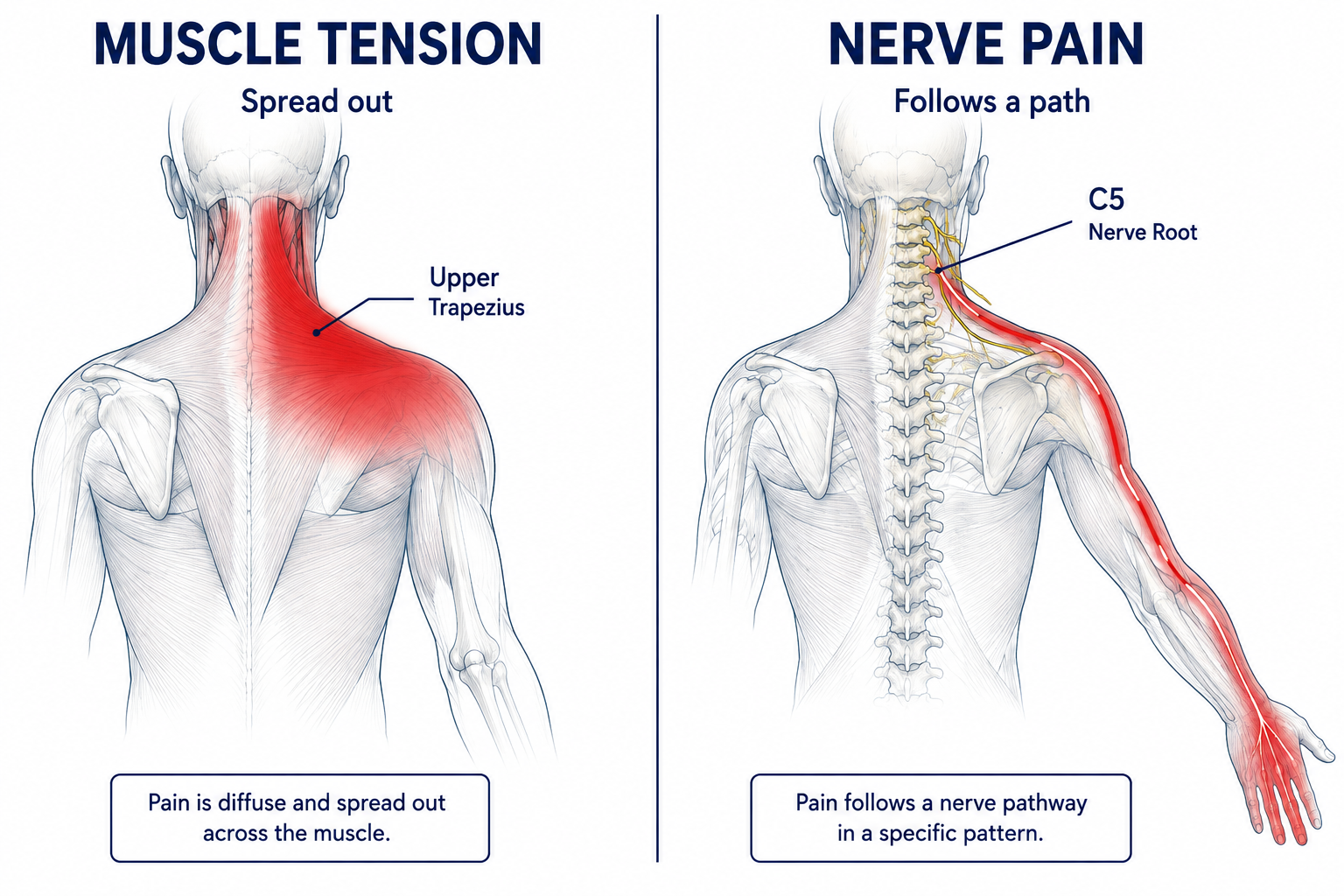
Muscle pain is usually described in broad terms.
People tend to point with a whole hand rather than one finger, because the area involved is diffuse rather than a precise line.
Common characteristics:
Muscle tension can refer pain to nearby areas, which is where some of the confusion starts. A tight upper trapezius can produce discomfort up toward the head without any nerve involvement at all.
Nerve pain tends to be described with sharper words.
Burning, shooting, electric, and pins and needles come up far more often than aching or sore.
Common characteristics:
The travelling pattern is the most useful clue. Nerves follow predictable routes, so symptoms tend to run in a line rather than sit in a patch.
When irritation comes from the lower back, that path may run into the buttock and down the leg. When it comes from the neck, it may run into the shoulder blade, arm, or hand.
In practice, cleanly separating them is less common than people expect.
When a nerve is irritated, nearby muscles frequently tighten in response. That guarding is protective, but it produces genuine muscle pain layered on top of the nerve symptoms.
It also works the other way. Sustained muscle tension and poor positioning can contribute to the conditions that irritate a nerve in the first place.
So a person can have a tight, sore shoulder and a line of tingling into the hand at the same time, from one underlying problem.
This is why treating only the tight muscle sometimes helps briefly and then stops helping.
A few situations account for most of the mix ups.
For a closer look at nerve compression specifically, this may help: Can a Chiropractor Help With a Pinched Nerve?
Muscle tension generally tolerates movement, stretching, heat, and gradual loading well.
Nerve irritation is less forgiving. Aggressive stretching of an already irritated nerve can increase symptoms, and pushing into numbness or tingling is usually counterproductive.
The practical rule most people find useful is to pay attention to direction. Symptoms drawing back toward the spine and away from the hand or foot generally suggest things are moving the right way. Symptoms travelling further down the limb suggest the opposite.
That pattern is more informative than whether the pain level went up or down on a given day.
Some nerve symptoms should not wait.
Seek prompt medical attention for:
Beyond those, it is reasonable to have things examined if numbness or tingling persists beyond a couple of weeks, keeps returning, or is slowly covering a larger area.
Weakness in particular is worth taking seriously earlier than pain is. Pain fluctuates for many reasons, but progressive weakness is a more specific signal.
Distinguishing the two relies on more than symptom description.
An examination generally looks at how the area moves, what reproduces the symptoms, and whether nerve function itself has changed.
That commonly includes:
Imaging is not usually the first step, and it is often less informative than people expect. Disc changes appear on scans in plenty of people with no symptoms at all, which is covered here: Herniated Disc vs Bulging Disc: What Is the Difference?
Depending on findings, care may include manual therapy, spinal manipulation, or flexion distraction therapy when disc related nerve irritation is contributing.
Muscle pain is usually a dull ache spread over an area. Nerve pain is more often sharp or burning, follows a defined path, and can come with numbness, tingling, or weakness. Overlap is common, so an examination is what confirms it.
Muscle tension can contribute to nerve irritation in some areas, but most nerve root symptoms in the neck and lower back involve the spine itself rather than a muscle squeezing the nerve.
Many episodes of nerve irritation settle over weeks with sensible management. Symptoms that persist, worsen, or come with weakness should be evaluated rather than waited out.
Gentle movement is often fine, but aggressive stretching into numbness or tingling tends to aggravate an irritated nerve. If a stretch pushes symptoms further down the limb, that is a reason to stop.
Because it often is both. Muscles frequently tighten in response to nerve irritation, so the two commonly appear together from a single underlying problem.
At Niagara Falls Spine & Chiro, we examine whether your symptoms are coming from muscle tissue, nerve irritation, or a combination of the two.
If you have pain that travels, numbness that keeps returning, or tightness that is not responding to the usual approaches, an examination can help clarify what is involved.



Niagara Falls Spine & Chiropractic
716-205-8089 • 2303 Pine Ave, Niagara Falls, NY 14301