Call US TODAY - 716-205-8089

Pain between the shoulder blades is easy to ignore at first.
It often starts as a tight, nagging ache that you notice at the end of a workday or after a long drive.
For most people it comes from muscles, posture, or the joints of the upper back. Sometimes it is actually coming from the neck. Occasionally it is not coming from the spine at all.
That last group is rare, but it is the reason this area deserves more attention than a sore lower back. This guide covers the common sources, how to tell them apart, and which symptoms need prompt medical care rather than a wait and see approach. If your pain seems to start higher up, our neck pain page may also help.
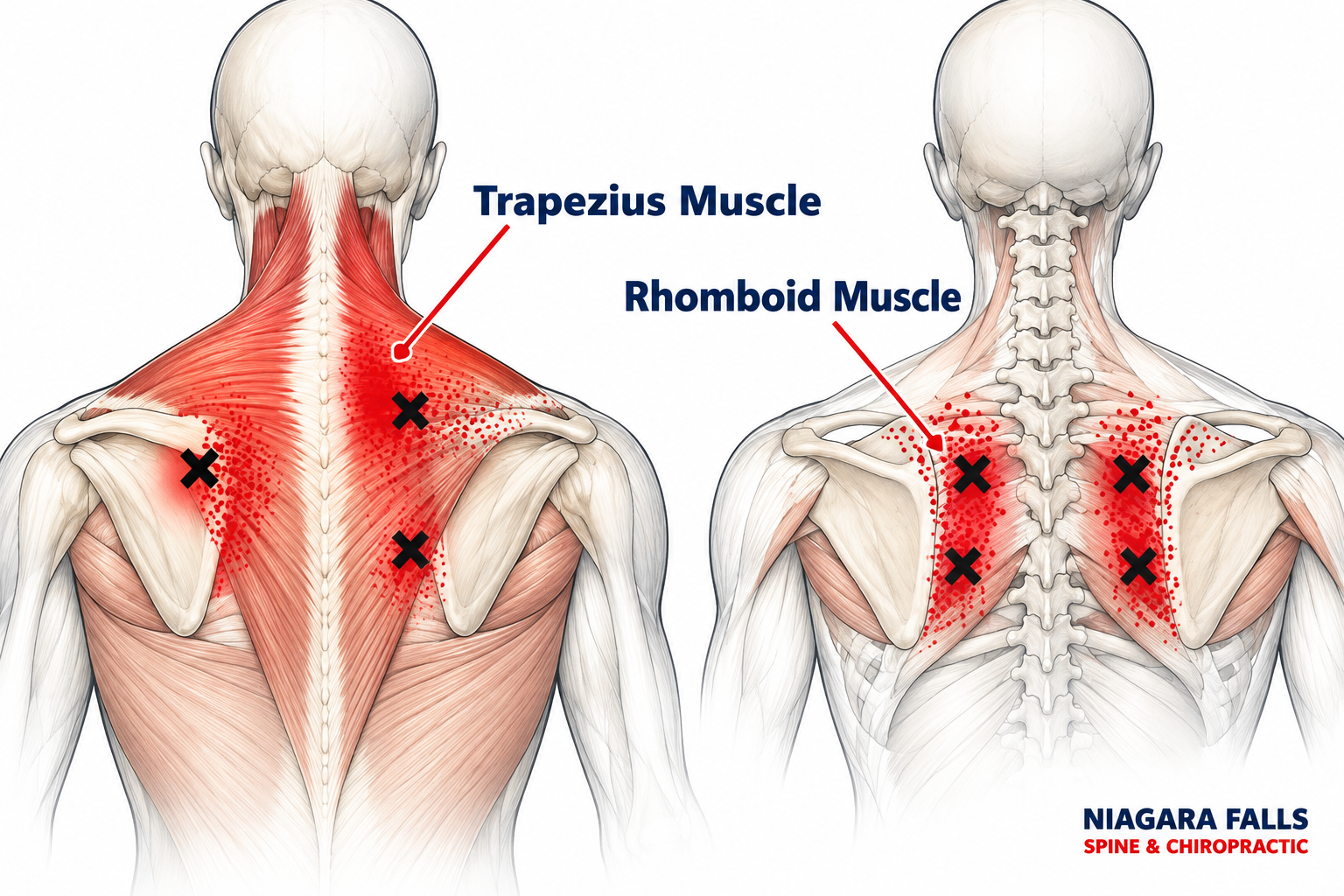
The area between the shoulder blades is crowded.
Several structures sit close together, and each can produce a similar ache:
Because these overlap, the location of the pain alone rarely tells you the source.
How it behaves usually tells you more.
This is the most common source by a wide margin.
The muscles between the shoulder blades work constantly to hold the shoulders back against gravity. When the head drifts forward and the shoulders round, those muscles stay on longer than they were built to.
Everyday habits that often feed it:
Muscle related pain tends to feel worse late in the day and better after moving around, a warm shower, or a weekend away from the desk.
If tension tends to settle in your neck and shoulders during stressful stretches, our page on stress and physical tension covers that pattern.
The thoracic spine is built for stability, but its joints can still become stiff or irritated.
Each rib connects to the spine at small joints on either side. When one of those joints is irritated, the pain can feel surprisingly sharp and specific.
Signs that point toward a joint source:
A sharp pain with breathing can feel alarming. When it is joint related, it usually changes with position and movement, which is a useful clue.
This is the one people miss most often.
Nerves and joints in the lower neck can refer pain down into the area between the shoulder blades, even when the neck itself does not hurt much.
It is more likely to be neck related if you notice:
When arm symptoms are part of the picture, a nerve may be involved. Our article on whether a chiropractor can help with a pinched nerve explains that pattern in more detail.
A similar thing happens with the shoulder itself. This article covers it: Is Your Shoulder Pain Actually Coming From Your Neck?
Most pain between the shoulder blades is musculoskeletal.
But this area can also receive referred pain from the heart, the large blood vessels in the chest, the lungs, and the gallbladder. That is why it is worth knowing the warning signs, even though they are uncommon.
Call 911 or go to an emergency department if pain between the shoulder blades comes with:
Heart symptoms do not always look like the classic picture. Women in particular are more likely to feel upper back pain, unusual fatigue, or nausea rather than crushing chest pain.
Other patterns that deserve a medical visit rather than a chiropractic one:
None of these are common. They are the ones worth knowing anyway.
Many people notice the pain mostly on the left or mostly on the right.
One sided pain is usually still muscular or joint related. It often matches your dominant arm, the side you carry a bag on, or the direction you turn to look at a second monitor.
Side still matters in two situations:
Outside of those, which side hurts matters less than what makes it better or worse.
For muscle and posture related pain, small changes repeated daily tend to beat one big fix.
Things many people find helpful:
Stretching alone rarely settles this area for long, because the muscles are usually tired from holding a position rather than short and tight.
If a movement sends pain into your arm or brings on tingling, stop and have it evaluated rather than pushing through.
Most cases settle within a few days to a couple of weeks.
It may help to have it examined if you notice:
If the pain began after a collision, even a minor one, it is worth reading about whiplash, which often shows up in the upper back as well as the neck.
Care depends on what the examination finds.
A muscle and posture pattern is approached differently than an irritated rib joint, and both are approached differently than pain referred from the neck.
Depending on the findings, care may include spinal manipulation for stiff upper back or rib joints, manual therapy or instrument-assisted soft tissue massage for tight or overworked muscles, and postural correction therapy when sustained positions keep the problem going.
Chiropractic care is one part of conservative care. It is not appropriate when the pain is coming from the heart, lungs, or gallbladder, which is why the examination starts by ruling those patterns out.
Sitting for long periods usually lets the head drift forward and the shoulders round. The muscles between the shoulder blades then work for hours to hold you up, and they start to ache.
Yes. A nerve irritated in the lower neck can refer pain into the area between the shoulder blades, sometimes with tingling or numbness into the arm.
It can be, although that is uncommon. Pain with chest pressure, shortness of breath, sweating, nausea, or pain spreading to the jaw or arm needs emergency care right away.
Muscle related pain often improves within a few days to two weeks. Pain that lasts longer, keeps returning, or comes with arm symptoms is worth having examined.
Heat is usually more comfortable for muscle tightness and posture related aching. Ice is sometimes preferred in the first day or two after a specific strain.
At Niagara Falls Spine & Chiro, we look at how your neck, upper back, and ribs move, and what makes your pain better or worse.
If pain between your shoulder blades keeps coming back or has not settled with simple changes, an examination can help identify what is driving it.



Niagara Falls Spine & Chiropractic
716-205-8089 • 2303 Pine Ave, Niagara Falls, NY 14301