Call US TODAY - 716-205-8089

Posture gets blamed for a lot of things it does not cause.
Headaches are one area where the link is real, but narrower than most people assume.
Posture does not directly cause every headache. What it can do is irritate the joints and muscles at the top of the neck, and those structures are capable of referring pain into the head.
That distinction matters, because a headache coming from the neck responds to different care than one that is not. If you already suspect a neck connection, this may help: Can Neck Problems Cause Headaches?
The upper neck and the head share nerve pathways.
The nerves supplying the top three segments of the neck converge with the nerve that carries sensation from the face and scalp. Because those signals arrive at the same place, the brain can interpret irritation in the neck as pain in the head.
This is called referred pain, and it is why a stiff upper neck can produce a headache behind the eye with no problem in the eye at all.
The structures most often involved:
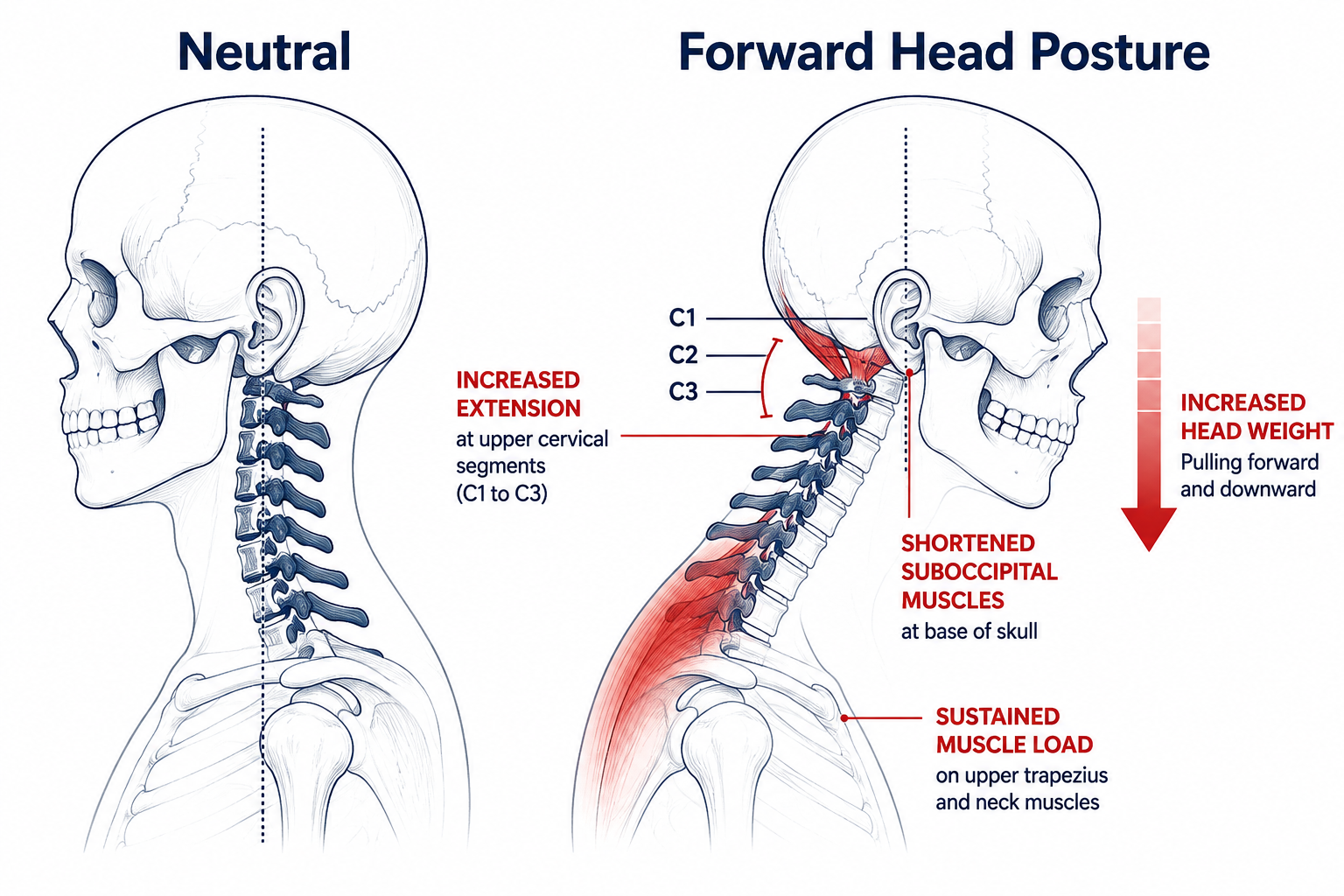
The head is heavy, and it is balanced on a fairly small base.
When it drifts forward of the shoulders, the muscles at the back of the neck have to work continuously to stop it dropping further. They do not get a rest while you hold that position.
Forward head posture also extends the upper neck rather than the lower neck. The small muscles at the base of the skull shorten and stay active, which is precisely the area most associated with headaches referred from the neck.
Held for eight hours a day, that adds up.
A headache that originates in the neck has a name: cervicogenic headache.
It is classed as a secondary headache, meaning it is caused by an identifiable problem elsewhere, in this case the cervical spine. That sets it apart from primary headaches like migraine and tension type headache, which are not caused by a separate structural source.
Cervicogenic headaches often share a recognisable pattern:
Tension type headache overlaps in some ways and is more often described as a band of pressure on both sides. Forward head posture has been found in both groups, but the mechanisms differ. Cervicogenic pain leans more on the upper neck joints, while tension type headache is associated more with muscular factors.
In practice the two frequently coexist, which is part of why self diagnosis is unreliable.
No single sign confirms it, but some patterns point that way.
Worth noticing if you have:
These suggest the neck is worth examining. They do not rule out other causes, and they are not a substitute for having it assessed.
The issue is duration, not the device.
Looking down at a phone tilts the head forward and increases the load the neck muscles carry. Monitors set too low do the same thing for longer stretches at a time.
Common contributors:
Small changes to screen height and break frequency often do more than any single stretch.
Plenty of people with poor posture never get headaches, and plenty of people with excellent posture get them regularly.
Posture is one contributing factor among several. Treating it as the whole explanation leads people to chase ergonomics while missing something else.
Posture is probably not the main driver when:
Headaches also have causes unrelated to the musculoskeletal system entirely, including medication overuse, which is easy to miss and common in people treating frequent headaches at home.
Most headaches are not dangerous. A few need immediate medical attention rather than a routine appointment.
Seek urgent care for:
These are uncommon. They are worth knowing so they are not dismissed as another posture headache.
Care depends on what the examination finds, and on whether the neck is genuinely involved.
When it is, conservative care often focuses on restoring upper neck movement and reducing the sustained muscle load, alongside changes to the positions causing the problem.
Depending on findings, that may include manual therapy, spinal manipulation, or postural correction therapy.
Chiropractic care may help some headaches that originate in the neck. It is not appropriate for every headache type, and migraine or other primary headaches generally need medical management rather than hands on care alone.
It can contribute. Sustained forward head positions load the upper neck joints and muscles, and those structures can refer pain into the head. Posture is a contributing factor rather than a direct cause.
Common clues are pain that starts at the base of the skull, stays on one side, worsens with neck movement or long desk sessions, and comes with reduced neck rotation. An examination is what actually confirms it.
It varies with how long the pattern has been present and what else is contributing. Many people notice change over a few weeks when workstation habits change alongside care, but there is no fixed timeline.
Stretching may ease symptoms temporarily. On its own it rarely resolves the problem, because it does not change the positions producing the load in the first place.
A pillow that holds the neck too high or too low for hours can contribute, particularly if headaches are worst on waking. It is usually one factor rather than the whole cause.
At Niagara Falls Spine & Chiro, we examine whether the joints and muscles of your neck are contributing to your headaches, and whether something else is more likely.
If headaches keep returning and seem to track with your neck or your desk setup, an evaluation can help clarify what is driving them.



Niagara Falls Spine & Chiropractic
716-205-8089 • 2303 Pine Ave, Niagara Falls, NY 14301